A landed aristocracy
“They do not form the general public; they are extraordinary people. They do not build their houses on the common soil; they live in high perched nests. But whatever their glory they cannot be the people’s spokesmen. They do a great deal of service to the British, but the British if they tried could not make them the people’s ‘natural leaders’. For even the British rulers cannot convert the impossible into the possible.”
—RABINDRANATH TAGORE, 1899.
We leave the town and make our way along the mud tracks that are the highways of Bengal. The morning sun tips with gold the paddy ripening in the fields—small fields of irregular shape, each one a patch of ground, the equivalent say of a hundred feet square. Between them run low earth walls, serving to hold back the water in the rains and used as pathways to the fields beyond.
We make way for a creaking bullock cart loaded up with bundled jute, its wheels running deep in the ruts in the earthen track. The driver, nodding to sleep, wakes with a start to twist the tails of his lean beasts and prod them into faster motion. Men pass us bound for market, each with the rice or vegetables he hopes to sell in a wicker basket on his head.
After half a mile of fields the jungle closes in again. Further on, swamps and water hyacinth and still more jungle with but a few patches cultivated here and there. Then we come upon it, the country seat of the aristocracy of Bengal.
In the jungle there stands an English country house, vast in extent, built in the classic [style] of a hundred years ago. But it is a ruin! The weeds and jungle have taken possession, a few bits of plaster and moulded cornices still hang on the brickwork, but the roofs have fallen in! We wander through the courtyards and look in the empty rooms. Three or four families, descendents of the builders, now occupy a portion of the wings. The many columned “Pujah Hall” where the Hindu peasants come and celebrate their religious festivals, still stands: in front of it, on the lawn, is the bamboo frame work erected for this year’s “Durga Pujah”. Around the huge homestead stretches a wide and shallow moat, now a swamp, with a few patches of straggling paddy trying to make its way up into the sun.
As we leave, an ageing man walks slowly by. We talk to
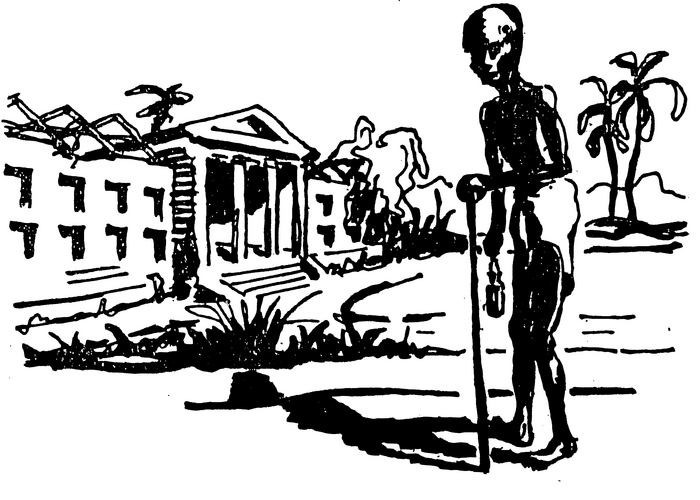
him, he is a tenant of this zemindar and he takes us to his village. He is barefoot and lean and carries a bottle of medicine with which he hopes to cure his little girl of fever. For this he has paid some quack eight annas, half of what he earns a day, and what he has is surely coloured water. He is a fisherman by caste. The zemindar is landlord of the rivers and the ponds as well as the land and he pays him rent to fish. Year by year the water is disappearing and giving way to swamp but he still has to pay. Of course he could leave, but where else to go? Fishermen are starving everywhere in Bengal and they cannot get yarn to make their nets or tar to soak the yarn. Few now have boats, and how many could afford [the] Rs. 200 a new one costs? The harvest is beginning and men are working in the fields—not many of them in their own fields however. We talk to one or two. They have no land at all, but are working for a bigger peasant and he pays them a daily wage. Others are gathering the harvest on land which once was theirs, but which now is the moneylender’s or the zemindar’s, who will take two-thirds of the crop the peasant reaps.
In the villages it seems strangely quiet. Some of the homesteads are dilapidated or in ruins and the ponds from which the people draw their water are overgrown and slimy green. A little group of men gather round us. Most of them look thin and ill, some wear nothing but a length of cloth about their middle, a few have tattered shirts. We ask them about their land. Some peasants in the village have enough to keep their families, they tell us, some even employ others to work for them as well. Of those talking to us, most had sold theirs in the famine to buy food and pay off debts. They have never seen their landlord, the zemindar, for he has a house somewhere in Calcutta—but they all know his agents and the moneylender. Two other men were also standing by, men carrying lathis (bamboo sticks used by the police) and when they leave, we ask the peasants who they were. They are the men whom the zemindar employs to collect his rent and debts, and they had come to take an old man to the office about what he owed. This man told us he had given them eight annas and bribed them to put it off a little for, he said, once they get you there it is difficult to get away—unless you have the money or the rice to pay, or unless you agree to take out another loan.
Permanent Settlement
This was the first I saw of the land system as it operates in Bengal—a poverty-stricken peasantry, peasants who do not own but rent their land, many of whom are dispossessed, virtually all of whom are in debt, with absentee landlords, their estates going to ruin, yet with such power that they even have their own armed men and usurp the power of the police. It is often explained that such conditions exist because “India is a backward peasant country”. How little is it realised that the present system of land tenure only goes back 150 years, that the landlords were actually created by an Act of Parliament in London in 1793!
For centuries before, even since the days of the ancient Britons, India had been a feudal country. Nobody owned the land in the modern sense. The peasant had the unassailable right to occupy and till his land and he made over a portion of his produce to his overlord who kept irrigation works in order, protected him and waged wars. There was little written law covering the rights of different people, just as was the case in early feudal England. The system had developed, was accepted and seemed everlasting. Out of this land system grew the village communities, each more or less self-contained and with their own weavers, blacksmiths and craftsmen. The villagers of course were poor, with their ancient methods of cultivation—many had a struggle for existence—but every peasant had his land. From these village communities was produced all the fabulous wealth of India, and they were so stable they outlasted all the waves of conquerors until the British merchants came. The East India Company, like its rival companies of other European countries, was after the wealth of India, the products of her villages and the revenue they paid to the Emperors and, by 1765, after ousting their competitors and after many military campaigns, the Company had managed to seize this revenue in Bengal.
However, a problem still remained for them how best to regularise and make permanent the annual extraction of this wealth. Their solution was certainly ingenious. Under the Moghul system there had been a class of people called “zemindars” whose function had been to collect the revenue for the overlords. They had had certain hereditary rights and, during the early chaotic years of Company rule, had gained considerably in importance. It was these men who, in a single stroke, were given the ownership of the land and were created landlords. How did this “Permanent Settlement”, as it was called, solve the problem of the Company? The zemindars were given the land on the condition that they paid over regularly to the Company a certain fixed sum previously determined and in this way the Company was guaranteed its annual revenue without having the bother of collecting it. As well, the British needed allies in Bengal, for their rule was far from easy at that time—and they found them in this new and powerful section of the people.
The results were catastrophic for Bengal. From London, of course, came eloquent assurances of Lord Cornwallis and others that “an English estate system” was being introduced with all its benefits and that the rights of the peasants were being protected. In reality the zemindars had been given the land, with a free hand to charge what rents they would, and the peasants had become tenants without rights and without redress. During the first twenty years or so, the zemindars did not have an easy time—they were bound to hand over the revenue by certain dates each year and the Company would accept no excuses of bad harvests or the inability of peasants to pay. There was wholesale selling of estates by auction during this period and the Company disposed of those virgin jungle areas just coming under cultivation, in which it also had full rights. Very often the worst type of Indian speculator gained possession of the land and these new zemindars began increasing the rents more and more—still only paying the same revenue to the British. In a generation or so they had amassed wealth enough to build those country seats and mansions we see in Bengal today. As the rents went up and up and the peasants became more and more impoverished, a bad harvest or a failure of the rains would mean ruin. Then they had to borrow money or rice to live, or seed to sow for the next crop, and the zemindars and their underlings eagerly entered the field as money-lenders, charging extortionate rates of interest. The peasant became more and more indebted, until mortgaged to the hilt, he had to sell. This process continued, and is still going on so that today up to a half of Bengal’s peasants have lost their land.
The only object of the zemindars was to get their rents; they had no other interest in the land. Often they would go
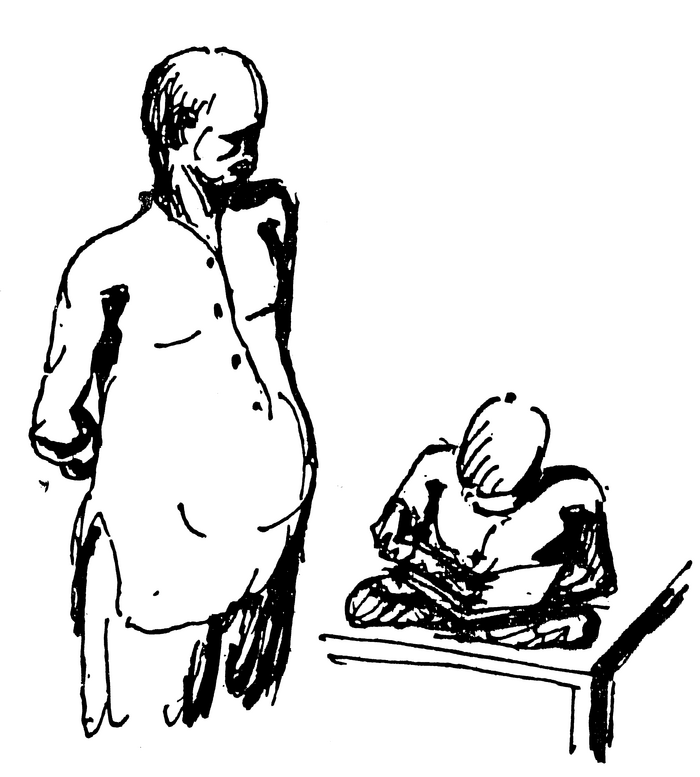
away to the towns and live on their wealth, and never see their land, but would sublet parts of their estates to others. These sub-zemindars, or “taluqdars”, would do the same, until today, above the peasant, there are several layers of land- lords and sub-landlords all living from his rent. These might number three or four, sometimes five or six, there are even cases up to thirty-six! Moreover, according to the Hindu custom of inheritance, under which the property of a father is divided amongst his sons, many of these estates decreased in size as time went on, until today some of the smaller land- lords have been reduced to severe straits and their homes are in ruins. Still, there are zemindars who hold vast estates, bigger than any landowners in England.
The Permanent Settlement has been condemned almost from its inception, and numerous Commissions have been set up to enquire into its workings, but still it continues. It has had profound effects on every aspect of Bengal today.
The land itself is dying. The zemindars have no interest in it, no more do many of those in the series to whom it had been sublet. Irrigation has been neglected and waterways have not been kept open, so huge areas of land revert to marsh and jungle. Impoverished peasants who do not even own their land are in no position to carry out such work as this.
It is from the Permanent Settlement that the Bengal society of today has developed. Virtually the whole of the present day middle classes, in the towns as well as the country, have arisen from the zemindars and still hold interests in land. In effect they are a vast class of parasites living off the backs of the peasantry. Most of the less wealthy ones do nothing more than keep a clerk, probably in an office in their house in town, where they collect their rent from whoever is below them in the scale of landholders. Perhaps, as well, they or members of their family are working as clerks or doctors, teachers or officials in Calcutta or the rural towns. At the same time, the old village society has been ruined and has been replaced by a system of zemindars, moneylenders and profiteers who have acquired the worst traits of oppression and usury, who have lost all previously accepted moral values. Moreover, the differences between the Hindus and Muslims have been sharpened—for nearly all the zemindars are Hindus and the vast majority of Muslims are peasants.
(This is the result, to a great extent, of the policy of the East India Company which very naturally favoured the Hindus to offset the Muslims who were the previous rulers of Bengal and from whom they had conquered power.)
Bengal was the first part of India where Parliament settled the land question for the Company. A similar arrangement was made for Bihar, Orissa and parts of Madras but a few years later, new systems were imposed in other parts. “Temporary Settlement”, where the amount of revenue is periodically reviewed and if necessary increased, applies in the United and Central Provinces, parts of the Punjab etc. A third system is “Ryotwari”, where the peasants rent land direct from the Governor. All have the same features—landlordism (this also applies to the “Ryotwari” areas where the bigger peasants gradually amassed more and more land), indebtedness and money lenders, and an ever increasing proportion of landless peasants.
There is one further feature of landlordism in India today—the Princes’ (or Rajahs’) states. There are three within Bengal itself. (Also there is a small area still under French sovereignty!) Throughout India there are 563 of these states, some as big as Spain, some of only a few hundred acres. These Princes and Rajahs are often described as the traditional rulers of their people but in fact they are zemindars, often fabulously wealthy, who rule as autocrats—with British “Political Agents” to ensure this rule suits the British administration. In the cases where they come from old ruling families, their ancestors had proved themselves “loyal” to the East India Company and had been suitably rewarded. Some states were bought for money—Kashmir, the largest state, was actually purchased by its rulers for the equivalent of half a million pounds. Large areas of some states are even leased, at a rental, to adjoining provinces. The boundaries of the states rarely bear any relation to communities or nationalities of people. They are even more backward than the rest of India, and their abolition is the first step in the liberation of India as a whole.