The peasants movement
“How many brigands have raided our country, how many times?
Ravaging village on village, piling up cruelties, crimes!
How many Bulbuls have ravished our grains,
Mothers have crooned of tyrannical reigns,
In spite of it all the proud spirit remains Of the people forever!
The peasant, the potter, the fisher, the blacksmith, the boatman, the weaver!”—“The People for Ever”, by BISHNU DEY.
Since 1936, when it was founded at a conference of Indian National Congress, the All-India Kisan Sabha has grown to the extent that, today, it is a power in the land which cannot be ignored either by the Government or by other sections of the national movement. At last the peasantry have their own organisation and can make their voice heard. By 1945, 850,000 of them were paying members of the Kisan Sabha and membership now is probably nearing the million mark.
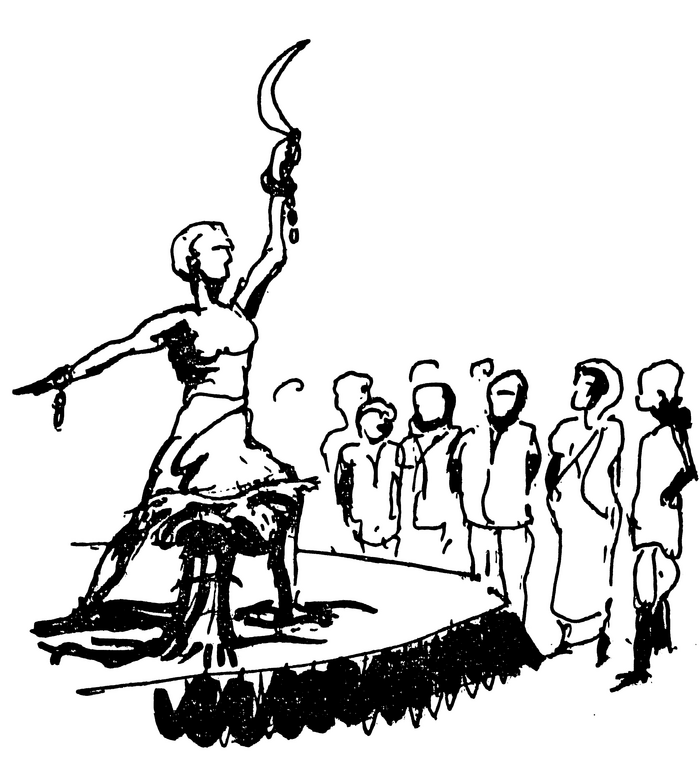
The all-India organisation holds annual delegates’ conferences and these in themselves are events which demonstrate the support there is for the movement and capabilities of the organisation. The 1945 session was held in Bengal—near Netrokona, a small town in the east of the Province. Delegates from practically every Province of India were there. It was estimated that 100,000 people were present at the open session, including many hundreds who had walked from 30 up to 90 miles distance. I heard something of the work involved in preparing for this great gathering from those who had taken part. Time was short—it had been intended to hold the session in Madras Province but the Government there had refused permission. 3,500 volunteers, nearly all peasants, worked to produce what was virtually a small township of bamboo huts. There were 100 acres of ground, two of these were enclosed and a covered bamboo structure was built for the 500 delegates. Kitchens were provided—altogether 45,000 cooked meals were served and the medical and sanitary arrangements must have been most efficient. There was an exhibition on view about the problems of the peasant and varieties of seed, implements and handicrafts were shown. A statue of the Indian Peasant, specially modelled after a Hajang member, stood in front of the main gate of the enclosure.
At these sessions the leadership for the coming year is elected and national policy is discussed and formulated. In 1945 the main resolutions were on food and famine and the “Grow More Food” campaign. The achievements of the Kisan Sabha throughout India were reviewed and village-wide unity was shown to be the only way to overcome the interests standing in the way.
Governments of different Provinces were called on to enforce a procurement policy of all food, at a guaranteed price, from the peasants and to carry this out with the participation of the peasants’ organ- isation and other democratic bodies so as to keep food out of private hands. A definite and adequate supply of cloth and
other necessities was demanded for the villages, to be distributed through Food Committees and other organisations of the people. The political resolutions called for the immediate release of the Congress leaders (then still in jail), for unity between Congress and the League and deplored the moves amongst a section of Congress to form a rival peasants’ organisation.
Bengal, as a Province, has the largest membership—about 250,000. Its special problems were discussed at its own provincial conference. In the main these were concerned with urgent measures for relief and rehabilitation. A survey of the present position showed over a million people as completely destitute while “semi-destitutes”—those who have been able
to carry on somehow—number nearly four million. Communities of artisans and fishermen had been nearly wiped out and over the whole Province, 9 per cent of the cattle had died and 12 per cent were sold. The State was called on to accept their responsibility for the destitutes by allowing minimum subsistence and medical aid; orphanages and work to be provided for the able-bodied ones: as many people as possible to be moved back to their homes and occupation; legislation to be improved and simplified to enable peasants to regain the land they had lost; measures to be taken for the supply of cattle and implements, free to destitutes and with easy loans to others; boats for fishermen to be constructed on a large scale and an adequate supply of yarn, looms, metal, etc., arranged for artisans and craftsmen; a minimum price to be guaranteed to the peasant for jute, sugar cane and other “money crops”, high enough to ensure his well being. For all this to be successful the Government must allow the fullest participation of the people and their organisations.
It is on the basis of such demands, demands which if implemented would save shattered Bengal, that hundreds of thousands of backward and illiterate peasants have been organised. What type of movement is theirs? What of its membership and its leadership? What is its significance in the wider field of Indian liberation?
Organised Peasant
Naturally the strength of the movement varies in different parts of Bengal. There are vast areas in which the peasants are as backward as ever—although in most Districts the organisation is, at least, established. On the other hand it has its strong areas—in one subdivision I visited, there were strong
bases in over a third of the Unions. But, while its present strength should not be over-estimated, what is certain is that it is growing and will continue to do so. A member of the organisation pays an annual subscription of one anna and takes a pledge to help to build up the movement. However its influence goes far beyond its paying membership—as can be seen in any well organised area. Here, out of many villages, there might be a few hundred members, yet one can stop any peasant in his village or in the fields and he will talk of “our Kisan Sabha”. The organisation will enter into his daily life in many ways, as it does for every one of them. It probably gave his family relief when they were hungry, it has given him new confidence to stand up against the zemindar or the moneylender, it might have achieved an increase in the cloth or yarn coming into the village, perhaps there is a school it helped to open. He probably gave a hand in the digging of some canal that saved the fields and there might be a communal store of rice, arranged through the organisation and to which he contributes—and he knows the rice there is safe out of the hands of the black marketeer and can be drawn in case of need. As well, members of the organisation and their supporters have set up and manage co-operative societies, even assist in the running of high schools. Their work in Food Committees and in organising the distribution of cloth and such like, has shown a degree of efficiency that has exposed the incompetent officials. They are efficient because they are democratic, because they have the confidence of and know the needs of the people.
It is often said that the leadership of the movement is in the hands of middle class people, and that therefore it cannot be said to be truly a peasants’ organisation. Of course it is a fact that a backward peasant cut off from the world and
not able to read or write, cannot undertake at once the organising work or the carrying through of campaigns that are necessary in any movement. Yet what the peasant lacks can be provided by an educated individual as long as he gets inspiration for his leadership from the peasants themselves and has a real understanding of their problems. If he has dropped all notions and prejudices of the middle class from which he comes, he will be playing a vital role in what is truly a peasants’ movement. The Kisan Sahha today has such leaders and the surest test is to see the way in which they encourage peasants themselves to take on positions of leadership. The more the organisation is developing the more this is taking place. For it is peasants who see most clearly and sharply the problems that face them and as they gain in education and experience they are able to take on the organising work in the day to day leadership of the movement.
An example of the contribution of middle class people might be taken in the development of peasant culture. The traditional forms of drama, song and verse in the village had lost their vitality, become debased or even disappeared as a result of the general deterioration in village society. A few years ago the the Indian Peoples’ Theatre Association was formed largely by middle class people. They studied the lost arts and revived them with the new and modern content of the problems facing the peasant today. They played in the village and at peasants’ meetings and found a tremendous response amongst the people for this form of expression which was so near to them. By now, however, their inspiration has had such an effect that it is a people’s art which is beginning to revive. Peasants are singing the songs at their daily work, songs are being composed in the villages. Moreover, previously unknown forms of culture have been brought to
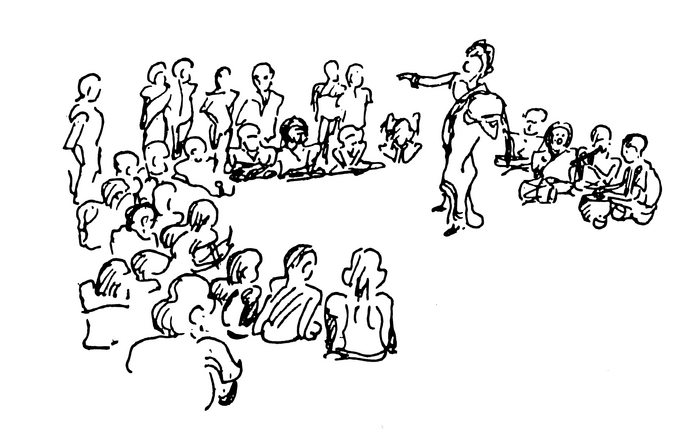
light and village bards who carried on these traditions have even been to conference in Calcutta, with their strange instruments and local verse and song. They are given new inspiration, they understand more of what are the real problems and issues of the peasant, and they incorporate this in their art and so ensure that once again the culture of the common people will flourish.
All too many people in the towns have a lack of faith in the peasants. They can understand a more or less spontaneous revolt by a ground down peasantry, but they cannot credit that peasants as individuals can comprehend complicated issues, take a leading part in an organisation, regularly work in it and manage its affairs. Many times I heard peasants dismissed as just “illiterate and backward”, the silent masses who have to be shown the way by political leaders.
But very often, I found far greater understanding of essentials from an illiterate peasant than from an educated townsman. To take a very simple instance. I, a Britisher, one of the race of overlords every peasant knows as the rulers of his
country, would appear in a village. Yet always, when it was explained that I was one of the common British people, that there are two sorts of people in Britain and that I was against the oppressors and the imperialists, a peasant would immediately and completely accept me as a friend and it would give him more faith in his own struggles to know that there were such friends across the seas. Yet some town people, even local leaders in the national movement, could never understand that I, a Britisher, was sincere. When I was critical of aspects of their movement, sometimes it was because I was “imperialist minded”, sometimes that I must have been a Communist—not that that there is such a thing as a sincere, though British, friend of India really interested in the problems of their movement.
From the struggles of his daily life, a peasant knows who are his oppressors, brown and white. He knows the zemindars and the hoarders are the enemies of the people, that they, as well as the British rulers, must go before there will be freedom. It is for this reason that the elections which are so violently disturbing the towns, mean so much less in the villages—even amongst those peasants entitled to vote. A typical comment I heard was that the only time they see these leaders is at election time when they come down making all their promises and yet they have never helped them in their daily problems. It is even worse when the candidate is a zemindar or a merchant himself, as is frequently the case.
One exception, in a well organised area, was where a leading member of the Kisan Sabha was contesting the seat as a Communist candidate. He was well known to the peasants and they knew him for their friend. Nevertheless in the villages there is very wide general support of Congress or the League. Many a peasant will answer that Congress is for
freedom and Muslims will say that Pakistan is for freedom for them. It is under these conditions that the extension of the franchise to the whole adult population becomes so important in India today. Then the common people themselves will be able to expose and remove their own reactionary countrymen from leading positions in the national movement - at present the candidates are elected mainly by middle class votes.
Already it is clear who are the friends and the foes of the organised peasant. Against the peasant movement are all those sections who oppress the people and who have arisen as a result of the Permanent Settlement—the oppressive zemindars and taluqdars, the moneylenders, the hoarders, the black marketeers. A merchant who profiteers will be afraid he will be exposed or his gains will be affected; a dealer will be opposed to them because of their demands for better prices for the produce of the peasants; a doctor who makes his money by swindling the people will be antagonistic because he knows they condemn him for not giving his skill to the poor. Opposed to the movement also are the officials, the authorities and the British administration, because their inefficiency and corruption are exposed and traditionally they repress any movement of the common people.
With the movement are all people who are for the common people and against oppression. It is a movement in which there is no Hindu-Muslim problem—all religions and castes are included because they are all united in their common interests. It is the movement for all peasants, prosperous and dispossessed, for all rural artisans, for all who are destitute and starving. As time goes on and they see what can be achieved by working together and their prejudices are broken down, more and more will find their place in the or ganisation. With them also are those people of the middle class who have surmounted their prejudices and are for real freedom for the people.
The programme of the movement is essentially concerned with the immediate issues facing the peasantry. Indeed the leaders to whom I spoke, strongly countered the tendency, very prevalent amongst town people and officials, to talk about and discuss long term solutions and forget the immediate problems of survival which stare the peasant in the face. As they pointed out, all power over the lives of the people, at present, is in the hands of anti-social sections—hoarders, money-lenders, black marketeers and such like—and, until the peasants and the people as a whole are aroused against them and are resolved to put an end to their methods, nothing real can be achieved. Nevertheless nothing less than the abolition of the Permanent Settlement will solve the problems of Bengal. The land must be given back to the peasants—they must be changed from tenants to real peasants again and the zemindars must be left with no more land than they can cultivate under their own direction. And later on, as the industry of India is developed, Bengal can go forward to large scale co-operative farming and the peasants can be lifted for ever from their backwardness and poverty and become human beings working together in prosperity for a common end.
There can be no doubt of the importance of the growing peasant movement in India today—for the first time these very backward peasants who form the mass of the people of the country, are organising and working together in their own interests. And is not their movement the parallel to the Trade Union movement which, as we have seen, has strongly developed in the industrial centres? For both are the organisations of the oppressed common people of India and it is
for this reason that they become so significant in the Indian scene today. But before we can understand the part they play at present, it will be necessary to consider the Indian National movement as a whole and see what is happening in the rural towns.