Small town politics
“In India the misfortune of being governed by a foreign race is daily brought home to us not only in the callous neglect of such minimum necessities of life as adequate provision for food, clothing and educational facilities for the people, but in an even unhappier form in the way the people have been divided among themselves.”
—RABINDRANATH TAGORE, 1941.
Election time in a District town is an experience a Britisher is not likely to forget. If there were half the commotion in a sleepy County town in England society would seem rocked to its very foundations and the proverbial old ladies and retired gentlemen would be behind their doors bemoaning that “the revolution has come!”.
In Bengal, however, staying indoors does not keep it out. Somebody would be there talking about the latest news or a rumour he had heard. Perhaps it is a report that Subhas Bose is not really dead or that in a nearby town the police are out after Muslim Leaguers had beaten up some Nationalist Muslims. It might be that a leading personality has blamed the Communists for the rowdyism in another meeting—such accusations and counter accusations fill the daily papers.
Even through the doors the muffled noise of shouting at a meeting or a demonstration might be heard. “Pakistan!” or “Congress zindabad!”. Most days there is some procession in the streets. Congress students perhaps, are shouting in unison the slogans of the I.N.A., “March to Delhi”, “Jai Hind”, then “Quit India”, “Quit Asia”—and if I were passing these last two might be directed, half grimly half good-humouredly, to me. Another day it would be the Muslim
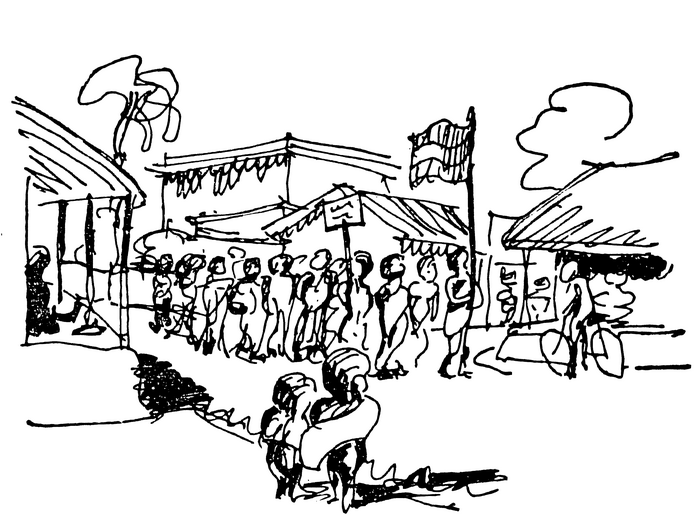
Leaguers demonstrating just as keenly for Pakistan and the defence of Islam, or the red flag of the Communists would be on the streets.
In England, even at election times, it is sometimes difficult to fill a public hail and party workers complain the people are so apathetic! Yet the comparative excesses of Indian politics are easy enough to understand. India is a subject nation under alien rule. The consciousness of foreign domination colours the whole lives and outlook of the people, its effects are felt on every hand. The British people have not had this experience, they have not suffered this humiliation, in this sense they are free. This tremendous latent feeling in India against British rule is particularly captured by Congress with its cry of “Quit India”. I was in a Bengal town when reports came through of police firing on the students in Calcutta. One could feel the tenseness in the atmosphere, see the little knots of people in the streets and sense the news being passed around in every home. Next day this burst out into protests and demonstrations, even some small amount of rioting, against the British Raj. There was a ‘hartal’ all day long when not a shopkeeper took down his shutters or a rickshaw appeared on the streets.
At the same time amongst Indians themselves there are complex cross currents and differences of interest. During the two hundred years of foreign rule the old society and old relationships have broken down, people have been set against each other, those holding land against the peasants, the moneylender and the profiteering merchant against the common people, Hindu against Muslim. All these sections have their influence within the different parties of the national movement. Bengal, like India itself, must go through many tribulations before she once more finds her soul. How different in the villages is all this politics! There the elections seem unreal while the town is in a fever. The peasant feels his immediate oppressors to be the zemindar and the hoarder—Bengalee oppressors. The town student feels that by the British quitting India or by achieving Pakistan all will be solved. How real is this difference between the town and country?
In the towns politics are essentially middle class politics. There are no peasants, and no industrial workers except
a few in the railway yard perhaps and small shopkeepers and craftsmen do not take the lead in political movements. So it was inevitable that the educated middle class people should have played the leading role in town politics—more than that, that they should have led the national movement as a whole. When nationalism and ideals of freedom were developing in India the peasants were remote and backward, they were completely unorganised. On the other hand the educated man knew what was going on elsewhere in the world, he had learnt there were alternatives to poverty and subjection.
A middle class man probably has a struggle to exist.
Even after a college education he might find himself without a future. If he is prosperous and in business he will feel thwarted at every turn by the dead hand of British financial control over India. Yet, however much he feels for freedom, he still remains one of that class living off the peasantry, a parasite of the land, and, unless he consciously cuts these connections, he will never get the ear of the peasants—the mass of the people. Further, his very conditions of life tend to make him accept as inevitable a less fortunate class of people. He might not rigidly accept ideas of caste and inferiority, yet he probably does not realise that if “the poor are always with us” was said of England, it is a hundred times more true for India. With a continual surplus of labour, menials do his heavy and unpleasant work, if his household is of any standing it will have a bevy of servants of different sorts and to save him walking in the heat, a rickshawwallah will always pull him for a pittance.
So when I discussed things with middle class people in the towns, whether or not they were leaders or whichever party they supported, I would like to know their relationship
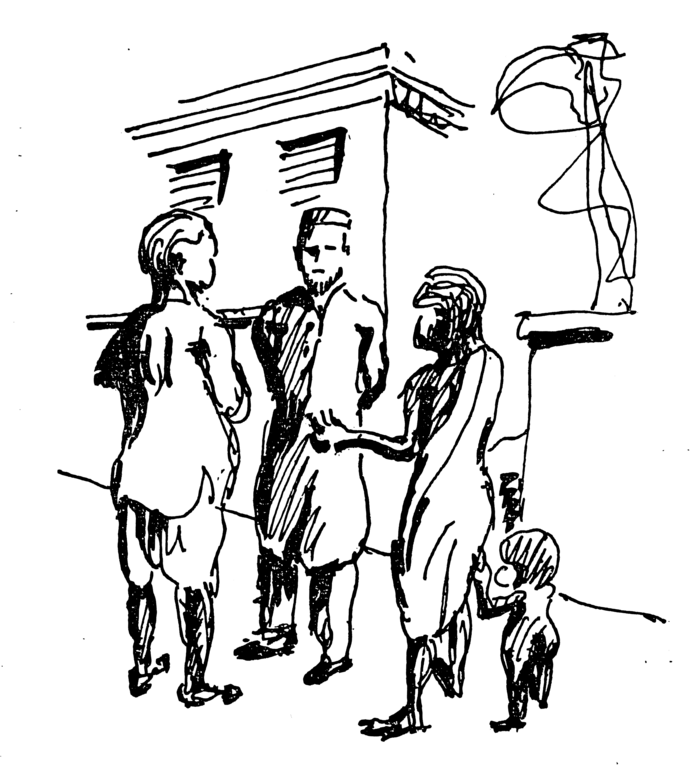
and attitude to the peasantry and the common people. Most had some interest in land, but a doctor or a lawyer, for instance, might be sincere and giving his services to meet the crying needs of the people, or, he might be a quack, deceiving the poor and doting on the rich. A shop keeper might be a black marketeer or an honest man. A prosperous dealer hardly could be honest with bribery and corruption accepted to the degree they are, as a means to business. As for the officials, the miserable low paid clerks are amongst the poorest
of the people, but, for this very reason, often fall prey to petty corruption, and their desire to hold their jobs is so great that they are often afraid to do anything that might be to the displeasure of their superiors. As for the higher officials, they are relatively very well paid and certainly have their stake on the side of authority.
True Patriots
There are many people from the middle classes—and I was continually meeting them—who had overcome all these handicaps and thrown themselves completely into the liberation movement. Such individuals make personal sacrifice and fight against the forces of authority in a way which is difficult to conceive in England today. They are the men and women who are preparing the future for the Indian people. A typical instance was a man who, in 1921, had joined the Non-Cooperation Movement of that time, giving up what probably would have been a brilliant official career. He might have been a District Magistrate, now, instead he is penniless.
He had sold his property years ago to finance some nationalist paper and had been three times in jail. Well may the Indian People be proud of the record of Congress in the past and of the struggles that have been carried out in its name. Most of those who take an active part have seen the inside of a prison, sometimes even as schoolboys they were arrested. Authority has not learnt yet that its methods hold no terrors for an Indian fighter—for he has a cause for which he is prepared to die.
Such men also were the “Bengal terrorists” and I heard many graphic stories from those who, in their younger days, had been in one or other of these organisations. They do not
agree now with their old terrorist methods, rather they look on what took place as a phase in the development to maturity of the liberation movement. Today there is virtually no terrorist movement in Bengal and many of the individuals are now taking a leading part in the organisation of the peasantry. The point of view they held was that, by devoting their lives to heroic exploits against the British rulers, by collecting and manufacturing arms and assassinating selected hated officials, they would so arouse the people that the British would be forced to leave. They were successful in a number of instances—although on occasion the homemade bomb would kill the man who threw it. In Bengal the memories of their deeds still live. From every quarter they are looked on as selfless and heroic patriots devoted to the cause of Indian freedom and some of their names have become household words. Although they were, of necessity, a closed circle working underground, I had many instances of the support the peasantry gave them—when they were hunted they would be fed and concealed in the villages from the police.
The authorities were ruthless in their suppression and sometimes, as in the famous Chittagong Armoury Raid in 1930, this needed a minor military operation. There was a whole series of trials of those caught and charged with assassination, of illicitly securing and making arms or of taking part in the organisation. Many were hanged, others received long sentences. Women were included—one girl of eighteen was sentenced to life imprisonment and released eight years later only after strenuous protests. A boy sentenced when he was fourteen was recently released as a man of thirty-four. Many were transported to the notorious Andaman Islands and it was here they staged their famous hunger strike
in 1937 when they were joined in this by political prisoners in jails all over India. India was aroused, Gandhi himself took up their cause and in 1938 he was assured by the authorities that the prisoners would be released that same year.
Eight years have passed and many of them are still not released.1 Some whose terms expired have been re-arrested at the jail gates and indefinitely detained under Ordinance. It is beyond doubt that they have renounced their terrorist ideas— the Government itself was convinced of it in 1938 when they were to be released. Incredible as it may seem, in 1942 the Government made use of their prestige by actually reprinting in official propaganda leaflets their appeals to the people of Bengal to unite and resist the Japanese invader, while at the same time they kept the writers behind bars. One wonders if the fact that while still in jail many of them have joined the Communist Party, has not some bearing on the attitude of the authorities. I realised what real patriots all of them are when I saw those who are out amongst the people. Some had only played a minor part in the organisation, yet each had done his job with a knowledge of the consequences to him if he were caught, and with a conviction that he was playing his part to free his motherland. One man, for instance, was entrusted with nothing more than periodically carrying a parcel and placing it on a certain seat in a bus—in an undergound organisation one does not ask the destination, someone else will receive it and pass it on. It is such men as these whose hearts are with the common people, who can assist them in their fight for freedom. No British friend of India can rest
1 The pre-Reform prisoners including the Chittagong Armoury Raid heroes have been released since though many others of [the] August 1942 movement, [the] R.I.N. Mutiny and the I.N.A. are still In jail.
until these prisoners are freed. True, the methods they used would not be countenanced in Britain, yet it was the character of British rule that made true patriots develop such ideas.
Fire Of Youth
What of the educated youth of Bengal today? In the schools and colleges is an ossifying system of education, but amongst the students, there are most militant movements reflecting the problems that beset the middle classes as a whole today.
High schools take children up to age sixteen and finish with the Matriculation examination. They are in every town and in some large or Union villages serving children from the rural areas. I particularly remember two of them I visited because they were so very different. One was an old established boys’ school in a fair sized town, and I sat in the headmaster’s room and talked with him for half an hour. It was rather a painful half hour, the whole thing such a pale reflection of old fashioned English notions and all rather pathetic.
I saw the accounts of the old boys who had become famous, the record collections the school had made for this or that charity, even a framed congratulation from the Governor of Bengal. All the teachers—there were about ten—sat in front of us, and during the whole time they never said a word, they never asked what such a secondary school in England would be like, what I thought of their school. I was relieved when I got out and sat down in an empty classroom with a few boys who proceeded to try out their English on me. They were interested and intelligent and it was very refreshing. This school was assisted financially by the Government and as in all such schools, the chairman of the managing board was the S.D.O. (so he is in on education as well as everything else!).
The pupils pay from to 3 rupees a month and when I learnt more of condition [some words missing here, perhaps referring to teachers] sympathy. They earn from 15 to 60 rupees a month! For this they have graduated! Normally they make up this money by private coaching in all their spare time.
No wonder teachers left the schools during the war and got temporary jobs as clerks.
The other school was in a small town and was self supporting. It had been built and was largely maintained by local donors, and was recognised for the Matriculation examination. It was altogether exceptional. There was a keen committee of twelve, three of whom were teachers and another the local secretary of the Kisan Sabha. The building was
very poor, typical of High School, the classrooms holding about 40 pupils each and with old benches and mud floors.
I asked why they did not apply for Government assistance.
The headmaster said if they did, Education Inspectors would be entitled to come and they would prevent them managing the schools as they did now and many of the teachers would certainly be removed as they held progressive views. Although it was financed privately, Government approved text books still had to used. I had seen these elsewhere. I had opened the English primer at “The Charge of the Light Brigade”, it was full of such examples. The picture of benevolent British rule in India, and the empire given in the history book was certainly not the source of the boys’ ideas on the subject.
On one or two occasions I had discussions with teachers on the curriculum and the standard of education. They were concerned that there was so much “cramming”, that the pupil’s sole idea was to pass the examinations to qualify him to get a job. This also applies in England, as I told them, but certainly not to the same degree. It was surprising to hear that it is only comparatively recently that most text books have been in Bengalee. When a student received his instruction in English, and had to learn and think in a foreign tongue, it was no wonder his education suffered. I asked whether the pupils ever disagreed with or discussed some of the things in their text books which are so much at variance with the viewpoint of Indians generally. Very little it seemed, again their chief concern was what answer would the examiner [want] and beyond that they were not very concerned—at least while in school.
College education gave a similar picture—except that I did not hear of any which had broken away to any great degree from the deadening tradition. They are all under the clammy hand of Calcutta University and once again education had not developed in an Indian or Bengalee way, but was just a lifeless imitation of foreign ideas. I learnt later that 80 percent of the Senate, the governing body of Calcutta University are appointed by the governor. Thus right from the top down to each of the local High Schools (where the S.D.O. is the chairman of the Board) authority holds the key position. No wonder a Professor bitterly remarked to me, “Even intellectually we are a subject nation”.
There were more colleges than I had expected—at least one in each district I visited. The majority of the students were Hindus. Even in an area where 85 percent of the population were Muslims, Muslim students at the college were less than 40 per cent and out of the twelve professors only two were Muslims. It was significant also that during the famine, at the very time primary schools in the villages were disappearing, at least one new college was opened—that was in a stricken district.
Outside education hours the students are much more lively. As well as college students, high school boys from about twelve years old or so are in their students’ organisations and they were very surprised when I told them this was a thing unheard of in England. For many years students have been to the forefront of the national movement. One young man I spoke to had been expelled from his college with twelve others a few years ago, because they had taken a leading part in two strikes. One of these strikes had been about a certain national song and continued for three months until the college allowed them to sing it at their functions.
One youth, secretary of the Federation in his high school, said that about half the boys were members—and he was
rather contemptuous of these others who did not join because they were afraid it would affect their chance of getting a job. He himself had had to report to the police station twice and had been told to desist and threatened that if he refused he would be barred from any official service!
What are the students striving for today? There is no single answer, they are not united. They are all for freedom. Beyond that, is it true to say that most of them feel things rather than try to clarify their minds on the way forward for the mass of the common people of India, that they are largely carried away by emotion? Most are clear what they are against, against British rule, against the Communists, against Congress if they are Muslims, against Pakistan if they are Hindus. Although they are conscious enough of the poverty and oppression of the peasants they do not think it very important to discuss them, or how far the solution of these problems is involved in the objective of all Indians’ freedom. If they are for Pakistan somehow this will solve all oppression. If they are for Congress these problems will all be solved after the British quit India. If we consider these two points of view we might be able to see which one is right—if indeed either point of view is right.